
On this page · 14 sections
- The matrix
- llms.txt: the most published, least read
- llms-full.txt: a convention, not a spec
- AGENTS.md: the one that plainly works
- agents.txt: a contested name, not a standard
- ARD / ard.json: the newest, with the clearest scope
- MCP: the settled layer
- MCP Server Cards: decided, with draft formats underneath
- WebMCP: the interesting one, behind a flag
- A2A: stewarded, versioned, boring in the good way
- Content Signals: policy, with real deployment
- What should we actually do in September 2026?
- Changelog
- Frequently asked questions
As of September 2026, public documentation identifies consumers for four of these ten standards; for the other six, we found only early, self-reported, or no consumption evidence. That distinction should drive an adoption decision, and most coverage of this space leaves it out.
This page is a maintained comparison. For each standard it says who is behind it, what its current status is, and what public evidence exists that anything reads it. Where the evidence is vendor self-reported or absent, we say so.
As of 1 September 2026, with the MCP Server Cards entry updated on 8 October 2026. See the changelog.
The matrix
| Standard | What it is | Steward | Status (Sept 2026) | Who demonstrably reads it | Our recommendation |
|---|---|---|---|---|---|
| llms.txt | A Markdown index of a site’s documentation, at a site or section root | Jeremy Howard (individual proposal) | v2, published 3 Sep 2024, modified 10 Aug 2026 | No major assistant confirmed. Lighthouse checks for it; Google Search does not use it | Optional. Publish only if you will keep it accurate |
| llms-full.txt | A single file concatenating full documentation text | Convention; not in the llmstxt.org spec | Informal | No confirmed consumer | Skip unless a specific partner asks for it |
| AGENTS.md | Durable repository instructions for coding agents; nearest file wins | Open format, multi-vendor | Stable, widely implemented | Coding-agent harnesses across several vendors | Adopt if you have a repository agents work in |
| agents.txt | Proposed capability declaration at a well-known path | Contested: one individual I-D plus several unrelated projects | draft-car-agents-txt-wellknown-00, submitted 12 Jun 2026, expires 14 Dec 2026 |
Nothing | Avoid. The name is not settled |
| ARD / ard.json | A manifest inventorying invocable resources on a domain | ards-project (authors at Google, Microsoft, Hugging Face); Apache-2.0 | v0.91, “Proposal”, 26 Aug 2026 | Publicly announced discovery services; small publisher evidence | Optional, low cost. Publish if you expose tools or agents |
| MCP | Protocol for exposing tools, resources and prompts to AI clients | Model Context Protocol project | Spec revision 2026-07-28 | Documented support across widely used agent hosts | Adopt if you expose tools |
MCP Server Cards / ai-catalog.json |
Static discovery document for a remote MCP server, listed in a domain’s AI Catalog | MCP project; AI Catalog working group | SEP-2127 merged as Final, 6 Oct 2026; card schema and AI Catalog both still drafts | Cloudflare’s scanner; SDK support in open pull requests | Optional. Publish with an AI Catalog if you want MCP clients to find a remote server, and re-check the drafts |
| WebMCP | JavaScript API letting a web page offer tools to an agent in the browser | W3C Web Machine Learning Community Group | Draft Community Group Report, 26 Aug 2026; Chrome origin trial | Chrome behind an origin trial; audited by Lighthouse | Experiment only. Not a W3C standard |
| A2A | Agent-to-agent protocol, with an agent card at /.well-known/agent-card.json |
Linux Foundation (donated by Google, 23 Jun 2025) | v1.0.1, released 28 May 2026 | A2A clients and registries | Adopt if you expose an agent to other agents |
| Content Signals | Content-Signal: directives in robots.txt separating search, AI input and AI training |
Cloudflare; policy text CC0 | Published 24 Sep 2025 | Honoured by Cloudflare’s network; declared by ~4% of top domains | Adopt if you have a view on AI use of your content |
Everything below expands a row. Skip to the one you are deciding about.
llms.txt: the most published, least read
What it is. A Markdown file listing a site’s documentation in a curated, link-annotated form, so an agent can orient without crawling. Version 2 of the proposal, modified 10 August 2026, loosened the format considerably: the file may now live at any path and cover the pages beneath it (/docs/llms.txt), Markdown twins may be served at page.md or page.html.md, and discovery may go through rel="alternate" type="text/markdown" or rel="describedby". The v2 text describes itself as “updated based on what I learned from two years of adoption.”
Who is behind it. Jeremy Howard, as an individual proposal. It is not a standards-body document and has never claimed to be.
Who reads it. No major assistant has been shown to. The evidence:
- Google says you do not need it. Search Central’s optimisation guide states that “You don’t need to create new machine readable files, AI text files, markup, or Markdown to appear in Google Search”, and that creating them will neither harm nor help visibility or rankings (Optimizing your website for generative AI features on Google Search, announced 15 May 2026).
- Google’s John Mueller called it a crutch. On 20 May 2026, asked why Google itself hosts llms.txt files, he wrote: “OF COURSE they can read HTML just fine, so this is imo more of a temporary crutch, perhaps to save some tokens” (Bluesky, 20 May 2026). A year earlier: “FWIW no AI system currently uses llms.txt” (17 June 2025).
- Google’s Gary Illyes compared it to the meta keywords tag. On 31 July 2025: “it’s very easy to draw a parallel between 1990’s keywords meta tag and this, and we all know how… useful the keywords meta tag became, very fast” (Bluesky).
- The measurement. Ahrefs checked 137,210 domains that received traffic in May 2026: 28% published an
llms.txt, and 97% of those files received zero traffic that month; of the requests that did arrive, 96% were bots and 19.5% came from named AI tools (Ahrefs, 15 June 2026). Ahrefs’ own caveat applies: its analytics customers skew SEO-aware, so 28% is an upper bound on publication, not a web-wide rate. - An earlier, larger, lower number. SE Ranking checked roughly 300,000 domains and found 10.13% had an
llms.txt(SE Ranking, 7 November 2025). The same study reported that removing thellms.txtvariable from its model of AI citations improved the model’s accuracy. Do not blend this with the Ahrefs figure. They are different populations, ten months apart.
One widely repeated number to avoid. The claim that “only 408 of 500 million” crawled pages or sites targeted llms.txt is not an Ahrefs finding and is not about sites. It comes from Limy.ai’s own blog, which reports monitoring “over 500M AI bot visits across a 90-day window - only 408 targeted llms.txt directly”. That is vendor telemetry over bot visits, self-reported, with no published methodology and no independent replication. If you cite it, attribute it exactly that way.
The counterweight. Chrome’s Lighthouse added an llms.txt audit in its agentic-browsing category (documentation, last updated 5 May 2026). This is regularly reported as Google contradicting itself, which overstates it: the audit returns Not Applicable on a 404, because the docs say “providing the file is optional at the moment.” A missing llms.txt is not a failure in Lighthouse.
Our recommendation. Optional. If you publish one, treat it as an index you maintain in the same release as the docs it points at. A stale llms.txt costs an agent budget and gives you nothing. Do not build a content strategy on it, and do not let a vendor sell you one.
llms-full.txt: a convention, not a spec
A single file containing full documentation text rather than links. It is not defined in the llmstxt.org proposal. It came from documentation platforms that wanted a one-fetch corpus. We have found no confirmed consumer and no measurement study. It is also the surface most likely to grow past a useful context budget.
Our recommendation. Skip it unless a named partner has asked for it. If you do publish one, cap its size and date it.
AGENTS.md: the one that plainly works
What it is. A Markdown file of durable instructions for coding agents working in a repository: build commands, test commands, conventions, hazards. Nearest file wins, so subdirectories can override.
Who reads it. Coding-agent harnesses across multiple vendors, as documented product behaviour. Of the standards on this page, it has the least ambiguity about consumption.
Our recommendation. Adopt, if agents touch your repository. Keep it short and operational: build, test, lint, conventions, things that will break. Do not turn it into a wiki, because length is a cost paid on every task.
agents.txt: a contested name, not a standard
What it is, or claims to be. A well-known file declaring what a site’s agents may do, positioned against robots.txt: as the Internet-Draft puts it, “Where ‘robots.txt’ expresses prohibition, ‘agents.txt’ expresses capability.”
Status. There is a genuine IETF submission: draft-car-agents-txt-wellknown-00, “AGENTS.TXT: Capability Declarations for Web Agents”, submitted 12 June 2026 by Kayla Cardillo as an independent individual submission, intended status Informational, expiring 14 December 2026. An expiring individual draft with no working group is a registration request, not a standard.
Separately, at least four unrelated projects use the same filename with incompatible formats. One of them renamed itself to agent-manifest.txt on the explicit grounds that the agents.txt namespace had become crowded. Cloudflare’s 22-check readiness scanner does not check for it.
Our recommendation. Avoid. Publishing an agents.txt today means picking one of several incompatible interpretations, and that ambiguity is the problem.
ARD / ard.json: the newest, with the clearest scope
What it is. A manifest at /.well-known/ard.json inventorying the invocable resources on a domain (MCP servers, A2A agents, APIs), with each entry pointing at that resource’s real description. The spec calls itself an envelope, not an execution mechanism.
Who is behind it. Three named authors, at Google, Microsoft and Hugging Face, with a wider acknowledgements list including GitHub, Cisco, Databricks, Nvidia, Salesforce, Snowflake and Amazon. Announced 17 June 2026. Apache-2.0. No W3C, IETF or foundation stewardship yet.
Status. v0.91, marked “Proposal”, dated 26 August 2026. There is no 1.0. The path changed: ARD designates /.well-known/ai-catalog.json as its predecessor, and ARD consumers MUST fetch ard.json while they MAY also consult the old path. The old path is still in use: it is now the path of the separate AI Catalog draft, which MCP Server Cards use (see MCP Server Cards below).
Who reads it. The project and adjacent vendors publicly announce discovery services, but we have not found independent usage telemetry for them. Publisher-side adoption is very small: an independent probe by API Evangelist dated 31 July 2026 found manifests from 9 distinct publishers across 37,751 reachable domains, none fully conformant.
Our recommendation. Cheap and coherent. Publish it if you expose tools, agents or an API: it is the only standard here that inventories invocable resources from your own domain. Do not expect discovery traffic from it in 2026. Full walkthrough: Agentic Resource Discovery: a practical implementation guide.
MCP: the settled layer
What it is. A protocol standardising how AI clients discover and call tools, read resources, and use prompts, with OAuth 2.1 based authorization on HTTP transports. Current specification revision: 2026-07-28.
Who reads it. Widely used agent hosts and client SDKs document MCP support. This is established infrastructure rather than a proposal, but support is not the same as proof that every agent host or workflow will use every MCP feature.
One design note. MCP treats tool annotations (readOnlyHint, destructiveHint, openWorldHint) as untrusted unless the server itself is trusted. They are selection and UX hints, not a security boundary, so enforcement has to live in your service.
Our recommendation. Adopt if you expose tools. Keep the tool catalogue small, and write the descriptions for a decision rather than an implementation.
MCP Server Cards: decided, with draft formats underneath
What it is. A static JSON document describing one remote MCP server (its name, version, endpoints and supported protocol versions) that a client can read before connecting. It leaves out tools, resources and prompts on purpose, because those are listed live through the protocol.
Status. SEP-2127 (“MCP Server Cards - HTTP Server Discovery”), opened 21 January 2026, was merged on 6 October 2026 and is listed as Final on the MCP site. An earlier proposal, SEP-1649, was closed in January 2026. The SEP is a chartering document: the detailed format lives in the modelcontextprotocol/ext-server-card repository, whose README still described the work as experimental on 8 October 2026.
The path is now decided. The card can live at any URL, with <streamable-http-url>/server-card reserved as the recommended location. Domain-level discovery goes through an AI Catalog at /.well-known/ai-catalog.json, a separate specification maintained in a Linux Foundation working repository, whose published text says it is “a draft document and may be updated at any time”. Earlier guesses such as /.well-known/mcp/server-card.json and /.well-known/mcp.json are not what the SEP specifies.
Who reads it. Cloudflare’s scanner counts server cards. As of April 2026, MCP server cards and API catalogues together appeared on fewer than 15 sites in Cloudflare’s filtered top-200,000 dataset. The Python and Go SDK reference implementations named in the SEP were open pull requests on 8 October 2026.
Our recommendation. Optional for now. If you run a remote MCP server and want MCP clients to find it, publish a card at the recommended location and an ai-catalog.json that lists it, generated from the same list as your ARD manifest, and re-check both drafts each release. This site lists its read-only MCP server in its own ARD manifest and will add a card and an AI Catalog when the formats leave draft. The ARD guide explains how the two files relate.
WebMCP: the interesting one, behind a flag
What it is. A JavaScript API that lets a web page register tools an in-browser agent can call, so an agent can invoke a page’s own functions instead of simulating clicks. Abstract, verbatim: “The WebMCP API enables web applications to provide JavaScript-based tools to AI agents.”
Who is behind it. The W3C Web Machine Learning Community Group, with editors at Microsoft and Google. The status text is explicit and worth quoting to anyone who describes it as a W3C standard: “This specification was published by the Web Machine Learning Community Group. It is not a W3C Standard nor is it on the W3C Standards Track.” Latest Draft Community Group Report: 26 August 2026.
Who reads it. Chrome, behind an origin trial. Lighthouse’s agentic-browsing category audits it (“Registered WebMCP tools”, “Forms missing declarative WebMCP”, “WebMCP schema validity”), and Chrome’s own toolkit post described the category as “informational and unbenchmarked” at publication (Chrome, 22 June 2026).
Our recommendation. Experiment, in a branch, if in-browser agents matter to your product. Do not ship it as your only path to an action, and do not let it substitute for semantic HTML. The same Lighthouse category audits accessibility for agents for a reason.
A2A: stewarded, versioned, boring in the good way
What it is. A protocol for agents to discover and delegate to one another, with a capability document published at /.well-known/agent-card.json.
Who is behind it. Donated by Google to the Linux Foundation on 23 June 2025 as the Agent2Agent Protocol Project. Current release v1.0.1, 28 May 2026, following v1.0.0 on 12 March 2026.
One correction. Some guides still show /.well-known/agent.json. That is pre-v0.3 naming. The current path is /.well-known/agent-card.json, and the spec includes an IANA well-known URI registration template.
Our recommendation. Adopt if you expose an agent that other agents should be able to find and call. Of everything on this page, A2A has the most conventional governance story: a neutral steward, semantic versioning, and dated releases.
Content Signals: policy, with real deployment
What it is. A vocabulary for robots.txt that separates three uses which a single Disallow collapses into one. From Cloudflare’s own description: “whether your content can be used for AI training (ai-train), whether it can be used as AI input for inference and grounding (ai-input), and whether it should appear in search results (search)”. In practice:
User-agent: *
Content-Signal: ai-train=no, search=yes, ai-input=yes
Who is behind it. Cloudflare, published 24 September 2025, with the policy text released CC0.
Who reads it. It is honoured within Cloudflare’s own network and included in Cloudflare’s managed robots.txt defaults. As of April 2026, 4% of domains in Cloudflare’s filtered top-200,000 scan had declared AI usage preferences in robots.txt. Whether a given crawler honours it is up to that operator’s policy, and nothing enforces it. Like robots.txt, it expresses a preference.
Our recommendation. Adopt if you have a view. It costs one line, it is CC0, and it lets you say yes to search and answers while saying no to training, which is what most publishers actually want and cannot express with a Disallow.
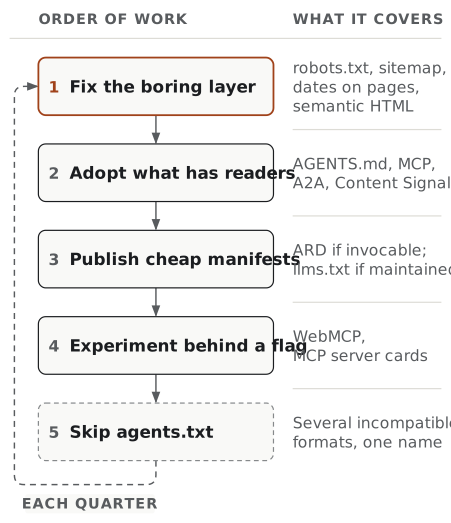
What should we actually do in September 2026?
A short ordering, with no outcome claims attached.
- Fix the boring layer first. A correct
robots.txt, a realsitemap.xml, dates on pages, semantic HTML. Every study cited above still points back here, and Google’s guidance is explicit that no new file replaces it. - Adopt what has readers.
AGENTS.mdfor repositories, MCP for tools, A2A for agents, Content Signals for policy. - Publish the cheap manifests, correctly maintained. ARD if you have anything invocable.
llms.txtonly if you will keep it accurate. - Experiment behind a flag. WebMCP, MCP server cards.
- Skip the contested name.
agents.txt. - Re-read this page in a quarter. Four of the ten entries above changed version, path, or status within the last six months.
Changelog
- 2026-10-08: MCP Server Cards updated. SEP-2127 merged as Final on 2026-10-06; domain-level discovery through the AI Catalog draft at
/.well-known/ai-catalog.json; card at<streamable-http-url>/server-card. ARD entry now says which specification each path belongs to. - 2026-09-01: first published. Ten standards. Status checked against primary sources on this date: llmstxt.org v2 (modified 2026-08-10), ARD v0.91 (2026-08-26), MCP 2026-07-28, A2A v1.0.1 (2026-05-28), WebMCP CG draft (2026-08-26), SEP-2127 open,
draft-car-agents-txt-wellknown-00expiring 2026-12-14.
Corrections and additions are welcome. Where we have marked something unverified, we would rather be sent the primary source than a summary of it.
Frequently asked questions
Does llms.txt actually work?
There is no public evidence that major assistants read it, and the best available study reports that almost none of the files that exist are ever fetched: Ahrefs examined 137,210 domains in June 2026 and found 28% published an llms.txt while 97% of those files received no traffic in May 2026. Google’s documentation states you do not need such files to appear in Google Search.
Which standards are worth adopting in 2026?
AGENTS.md if you have a repository coding agents work in, MCP if you expose tools, A2A if you expose an agent to other agents, and Content Signals if you have a view on how your content may be used. These have identifiable consumers. The rest are cheap experiments with thin or no evidence of readership.
Is agents.txt a real standard?
No. At least four unrelated projects claim the name, and the one IETF submission is an individual Internet-Draft with no working group, expiring in December 2026. No browser, search engine, or agent vendor has adopted it.
Why does Chrome’s Lighthouse check for llms.txt if Google says it does not use it?
Because they are different systems answering different questions. Lighthouse audits a page against emerging conventions; Google Search states its own ranking does not require the file. The Lighthouse audit also returns Not Applicable rather than a failure when the file is missing, which is a weaker position than the coverage suggests.
How is this page maintained? It carries a dated changelog and is reviewed when a listed specification changes version, changes steward, or publishes new adoption evidence. Every status claim is dated so you can judge how stale it has become.
Publish the standards that have readers, and the cheap ones that plausibly will, but do not mistake either for a strategy.